
Publishing frequency has no effect on backer patronage, so what does?
Findings from a study of Patreon data explored which creator-driven campaign variables are associated with higher levels of backer patronage.

Hi folks,
I’m back. I’m sure some of you didn’t even realize I was away, but I decided to take some time off from Substack to refresh my batteries.
And it felt great.

Upon reflection, I think I was caught in the Substack hamster wheel, feeling pressured to churn out weekly posts at the expense of my other writing projects.
So I simply walked away. I didn’t performatively announce my hiatus, I just stopped posting, and stopped worrying about feeding the algorithm.
I was worried about losing followers, but that only lasted a week and then I forgot about it.
It wasn’t just time away that helped ease my concerns, it was also another paper I read on the topic of subscription-based crowdfunding, which includes platforms such as Substack, which allow creators to employ recurring payments on a per-work basis.

This paper identified an interesting theoretical framework to ground their analysis, namely an alignment between motivation theory (backing for intrinsic and extrinsic reasons), signaling theory (backing because of creator campaign signals), and goal-based behaviour, which are all topics I’ve examined before, albeit individually.
Motivation theory posits that creators need to balance their need for a large and diverse number patrons with the need to offer personalized products and services. They can do this by offering multiple rewards or tiers. This leads to the first hypothesis, namely:
H1: Increased number and customization of campaign rewards positively affect patronage in subscription-based crowdfunding campaigns.
The second hypothesis arises from signalling theory, focusing on the extent to which creators interact with their supporters, either directly or via sharing of personal information. The second hypothesis is therefore:
H2: Increased campaign access in subscription-based crowdfunding campaigns positively affects patronage.
Finally, creators are incentivized to signal that their campaign creates new content over time. This leads to the third hypothesis:
H3: Increased signs of campaign health positively affect patronage in subscription-based crowdfunding.
To test these hypotheses, the authors randomly sampled a set of campaigns from a larger Patreon dataset (data collected between 2013 and 2023). The set of campaigns they identifiedhad at least n=10 supporters and had publicly displayed earnings, and random sampling led to the inclusion of 696 campaigns for analysis.
Their model for analysis is shown in the figure below, with Patronage identified as the dependent variable, defined by the highest cost reward tier that received funding. For the independent variables, these are constructed from the theoretical frameworks.
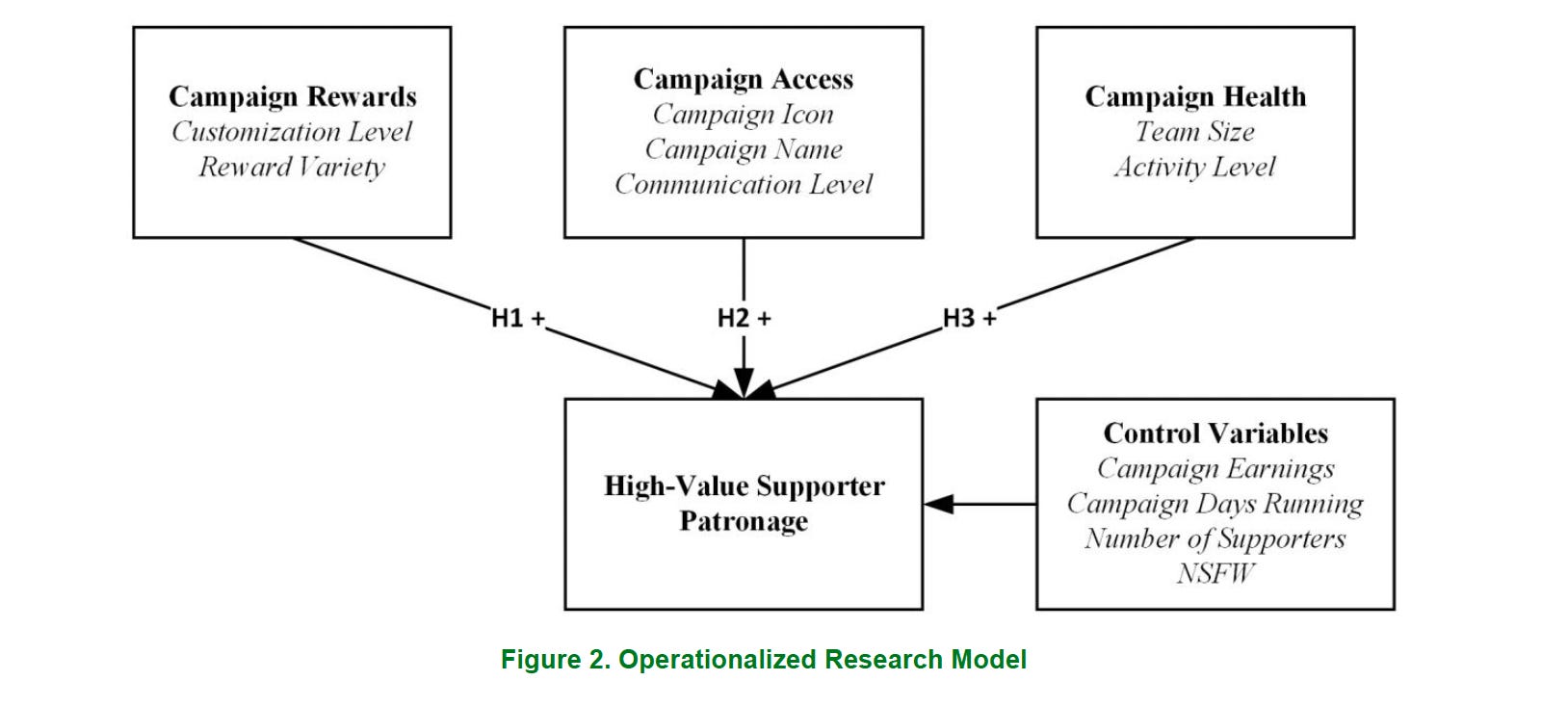
Campaign rewards are the domain associated with motivation theory, which speaks to extrinsic and intrinsic decision-making on the part of backers. The creator can incentivize such behaviour by offering different reward tiers, and different levels of customization. Note there are also other variables that could be constructed, but these are either harder to quantify across the dataset, or are assumed to be lower-order effects.
Campaign access arises from signaling theory and goal-based behaviour, where the creator sends signals about their campaign through choices they make about the layout, design, and content of their page, along with their direct (and indirect) communication levels. The authors also argue that creators who use their (real) names are more likely to receive backing than those who are anonymous, or simply use the campaign title.
Finally, campaign health also comes from signalling theory and goal-based behaviour, with the assumption that a larger team may lead to increased levels of content, and also that the general activity level of the creator is indicative of the health of the campaign.
Using a negative binomial regression, they found increased customization and reward variety were both associated with positive increases in patronage, therefore hypothesis one was supported.
For the second hypothesis, campaigns with icons and photos led to increase in patronage, as did campaigns offering increased personal access, but there was no association with campaign name and patronage so the hypothesis was mostly supported.
Finally, campaign health was not associated with increased patronage as both team size and activity were negatively associated with patronage. Hypothesis three was therefore not supported.
What does this mean for creators?
The analysis shows that customization and offering distinct rewards levels are associated with higher levels of patronage, as are creators sharing more personal information and having richer levels of communication with backers.
This isn’t exactly news, but it’s helpful to see it confirmed in the regression data. It suggests that successful subscription-based crowdfunding requires deeper connection between creator and audience. This is enhanced when the creator offers personalized rewards, distinct reward tiers, and is highly communicative with their audience.
The last one is where I struggle the most, as I often find it difficult to undertake that level of engagement. However, this paper convinced me that I need to at least try it, and then see what happens.
The most interesting finding from the paper was that more active campaigns (i.e., those publishing more frequently) don’t elicit higher levels of patronage.
This suggests more content isn’t better; that you don’t have to post every week to your audience. What matters is the depth of the relationship you develop with your audience, not how often you post.
It was this insight that helped me ignore the nagging voice in my head, and allowed me to take time away from weekly Substack posting. It goes against the standard advice that you must commit to a regular posting cadence (or else) in order to be succeed (whatever that means).
What do you think? Do you see how these findings could be useful for your own Substack? Or is there nothing new here?
Want to support my work?
If you’re looking for a cool sci-fi read this summer, then you should check out this anthology currently funding on Kickstarter. The campaign has already funded, so the publisher is hoping to hit some exciting stretch goals including an audiobook version.

I have a dark sci-fi tale in this anthology, which I really loved writing, and hope you’ll enjoy too. The campaign finished in mid July, so don’t hesitate and back it today.
If you’re a fan of earlyVertigo comics, then you should keep your eyes open for the Ms. Mist one-shot coming to Kickstarter this summer. This is an unsettling superhero horror comic about how we cope with lonliness, drawn by Sunado C., and published by Altruist Comics.

If this sounds like your cup of tea, then you should follow the campaign to be notified when it goes live.
Okay folks, I’ll catch you next time!
John
I write a weekly Substack column, Future Trends and Science Fiction https://brucelanday.substack.com/ and other than a couple of periods off due to health issues, I've been doing this for almost two years. At the end of May I told my readers I was going on hiatus for the summer so I could work on a new novel. I had a hard time going completely silent so I went to monthly posts. I was worried that my readership would drop but it hasn't. For the summer I'm still trying to write a weekly column but not scheduling them until after Labor day. I like having 6 to 8 weeks scheduled ahead of time so if I have a bad week where I can't write I don't stress over meeting a deadline.
I don't charge for my Substack and never will. Writing is a hobby and NOT a business for me. This gives me lots of leeway for experimenting. I found in general I got more subscribers when I was publishing weekly than monthly, but the drop off wasn't as bad as I expected. I also try to answer Notes and find that's a good way to be active while I can still be flexible on time investment.
Thanks for the analysis. My last job before retirement was doing data analytics so I'm Geeky enough to appreciate the details.
I’ve been assuming more frequent posting was the fix for slow growth, so seeing data that says depth of relationship matters more than cadence is genuinely useful. Personalization over posting schedule matches what’s actually moved the needle for me on Substack so far too.